Lý Công Uẩn: the monk-raised emperor
Raised at Cổ Pháp and taught by the monk Vạn Hạnh: a palace guard who took the throne two days after a king's death — and moved the capital.
Characters
Later tradition says Lý Công Uẩn was given at three to a monk called Lý Khánh Văn. The early chronicles do not name him, and his identity is contested.
Lý Khánh Văn is a name that appears in the story of Lý Công Uẩn’s childhood and not, as far as the early record goes, in the chronicle itself. The series compresses the childhood into a single clause — raised from childhood by the monk Vạn Hạnh — and this page exists to unpack that clause. The guardian tradition is later, the identity behind the name is contested, and the record the site quotes does not supply either.
The early histories do not name a foster father for Lý Công Uẩn. The Toàn thư gives the famous conception account, with the “thần nhân” omen; the Việt sử lược and the Tiền biên give only his mother, whose family name is Phạm. No early chronicle records a monk called Lý Khánh Văn raising him, and no early chronicle makes Vạn Hạnh his foster father.
What the site’s material does say is the compressed version: the cast note has Uẩn “raised from childhood by the monk Vạn Hạnh”. That sentence is the series’ shorthand, not a chronicle quotation, and the pages on Uẩn and Vạn Hạnh treat it as a compression.
The tradition that fills the gap is specific. At the age of three, Uẩn was given by his mother to a monk at Cổ Pháp named Lý Khánh Văn, was raised by him, and took the Lý surname; later, at six or seven, he was sent to study with Vạn Hạnh. On this account, a guardian and a teacher are two different men, and the series folds them into one.
The identity is contested. The reference page for “Lý Khánh Văn” redirects to Hiển Khánh vương; the histories do not record the name of Lý Công Uẩn’s father; some historians leave open that Hiển Khánh vương is the monk Lý Khánh Văn, or that the figure does not exist. The popular claim that Vạn Hạnh was Lý Công Uẩn’s father is rejected by historians, and the family tradition that makes Vạn Hạnh and Lý Khánh Văn brothers is contested too. None of this is settled by the chronicle.
The series never names Lý Khánh Văn. The cast note compresses guardian and teacher into one clause, and Season II–III material treats Uẩn as the monk’s charge. That compression is the thing this page corrects, not repeats: it is a dramatic shorthand that saves a character and loses a distinction.
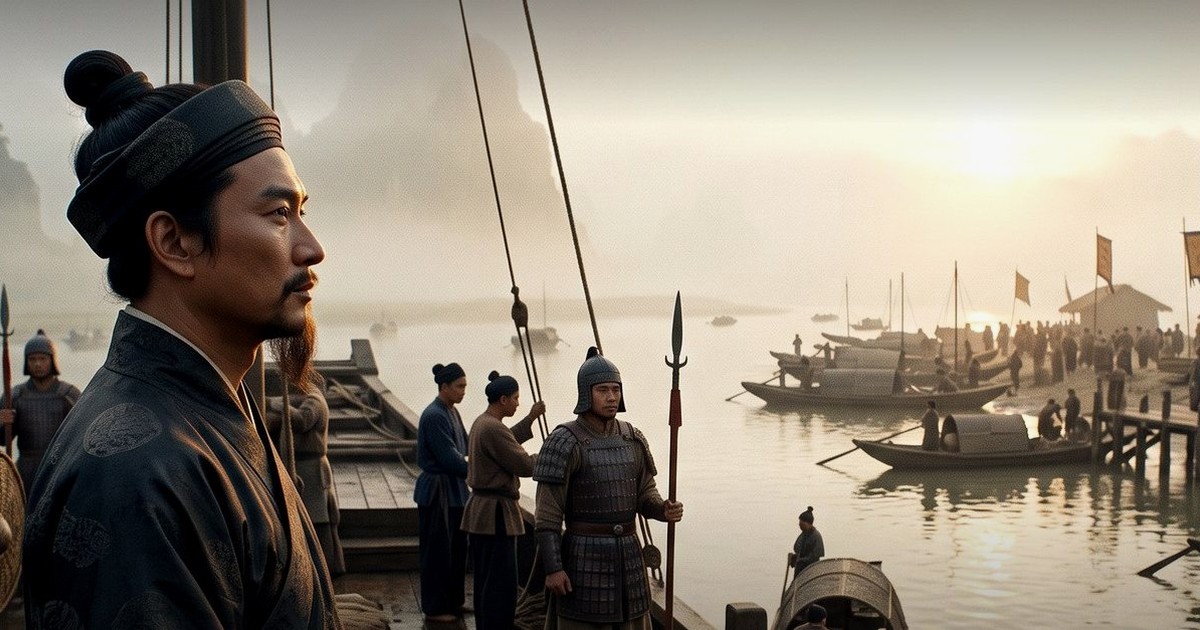
Everything here is hư cấu. No scene of the child being given to the monk exists in the published material; any such scene, with its dialogue and its farewell, would be invention. The still above shows Lý Công Uẩn on a boat at dawn — the ward, not the guardian — and no image in the project shows a monk called Lý Khánh Văn.
It does not make Lý Khánh Văn Lý Công Uẩn’s biological father. It does not make him Vạn Hạnh’s brother. It does not assert that he was definitely the monk of the tradition, or that he was Hiển Khánh vương. It gives no dates for him. And it does not present “raised by Vạn Hạnh” as the record: that is the series’ compression, and the record’s silence about the childhood is the honest starting point.
Because the difference between a guardian and a teacher is the difference between a family and a formation, and the series’ one-sentence compression hides it. Lý Khánh Văn is a test case for how tradition fills a chronicle gap: a name, an age and a surname, attached to a childhood the record does not describe. The page does not resolve him. It says where the name comes from, and why the record will not confirm it.
Raised at Cổ Pháp and taught by the monk Vạn Hạnh: a palace guard who took the throne two days after a king's death — and moved the capital.
The monk who taught Lý Công Uẩn and interpreted the omen the series withholds: what the chronicle records, and what later readers made of it.

A monk taught Lý Công Uẩn and interpreted an omen the series withholds: where the record stops, and what later readers added.