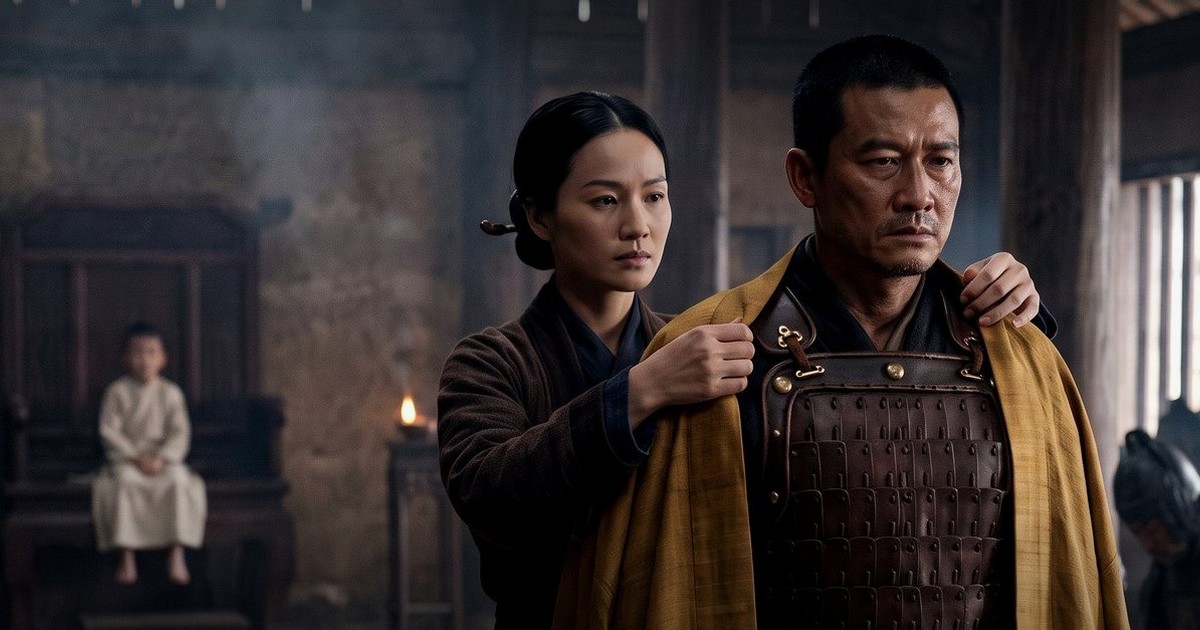
Dương Vân Nga and the robe on Lê Hoàn's shoulders
The dowager empress who ordered the imperial robe placed on a general's shoulders in 980: a lapse of virtue to some readers, vision to others.
Characters
Raised at Cổ Pháp and taught by the monk Vạn Hạnh: a palace guard who took the throne two days after a king's death — and moved the capital.

The series’ cast note compresses three clauses: an upbringing at Cổ Pháp under the monk Vạn Hạnh, commander of the palace guard under Lê Long Đĩnh, author of the Edict on the Transfer of the Capital. A character has to be built around that skeleton — and around one image, in which a man stands on the deck of a ship at dawn and looks toward the wharf at Đại La.
In the tenth month of the year Kỷ Dậu (1009), Lê Long Đĩnh died at the age of twenty-four by the chronicle’s count. Two days later, Lý Công Uẩn took the throne. The following year came the Edict on the Transfer of the Capital: Đại La became Thăng Long. The record gives four facts about him, and no portrait at all.
Nothing in that list says what he thought, how he spoke, or why the palace guard accepted him. The studio’s disclaimer describes the surviving sources plainly: “The surviving sources are few, were written later, and are often partisan.”
The two days between a death and an accession are where later histories go to work. The site’s history section sets four readings of Long Đĩnh’s death side by side, and one of them belongs to Ngô Thì Sĩ: the Tiền biên, printed in 1800, calls the epithet “Ngọa Triều” vulgar and baseless, and suggests that the Lý family may have poisoned the king and hidden it. The site labels this for what it is — a hypothesis written “nearly eight centuries later, with no contemporary evidence” — and keeps it in the Tiền biên rather than the Toàn thư. It names a family, not a man; nothing in the excerpted record implicates Lý Công Uẩn personally.
That distinction matters for how the character is read. If the hypothesis is true, 1009 is a coup and the Lý founding is stained. If it is false, the same two days are simply a succession. The series stages the possibilities and does not answer for the viewer. What it does not treat as uncertain is 1010: the edict, the move, the document. Its logline frames the whole project as a question about where legitimate power comes from — “the sword, the bloodline, or the pen of whoever writes the history” — and Lý Công Uẩn is the character who holds the pen.
The cast tag puts him in Seasons II and III throughout. Season II is 979–981: the feast night, the six-year-old emperor Đinh Toàn, the dowager empress Dương Vân Nga, the robe laid on Lê Hoàn’s shoulders, the Song army at the border. Lý Công Uẩn does not hold the centre of that story. He is a young officer in a court where the palace guard suddenly matters — which is the series’ reading of him, not a chronicle statement.
Season III is 1005–1010, and his episodes come last: “The Bedchamber”, then “The Edict on the Transfer of the Capital”. The series’ closing frame is explicit about what kind of ending that is:
“…where the dragon coils and the tiger crouches.”
The line belongs to the edict, attributed by the series to Lý Thái Tổ in 1010; the caption beneath it reads, “The series ends not with a battle, but with a document.”
Here the register changes. Everything below is hư cấu — invention — and the studio says so on its disclaimer page.
What makes Uẩn unusual among the series’ characters is how little the drama needs to add. A monk’s pupil. A palace guard. A death the record leaves unexplained. Two days. An edict that outlives the man who wrote it. The facts are fixed; the series supplies the person who lived between them. What it must not do is let the person overwrite the entries. The disclaimer says as much. The articles on this site try to keep the registers visible: what the record says, what later readers suspected, and what the drama chooses to imagine.
The dowager empress who ordered the imperial robe placed on a general's shoulders in 980: a lapse of virtue to some readers, vision to others.

A monk taught Lý Công Uẩn and interpreted an omen the series withholds: where the record stops, and what later readers added.

Lê Long Đĩnh died in the tenth month of 1009; two days later Lý Công Uẩn took the throne. The record explains the epithet — and four readings follow.