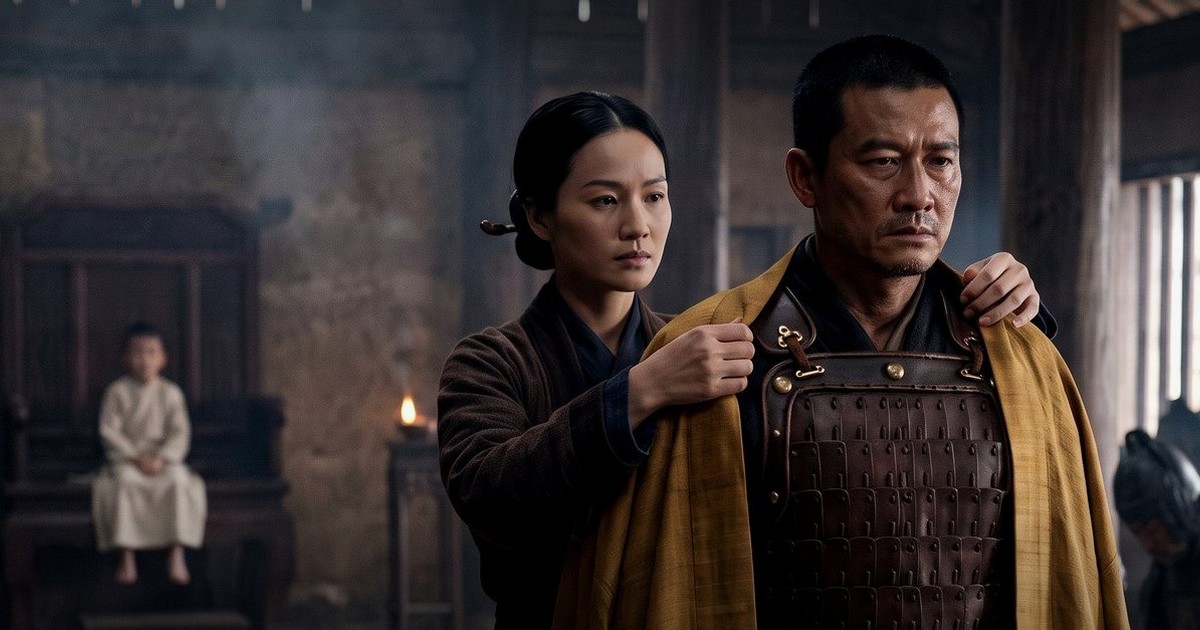
Dương Vân Nga and the robe on Lê Hoàn's shoulders
The dowager empress who ordered the imperial robe placed on a general's shoulders in 980: a lapse of virtue to some readers, vision to others.
Relationships
The robe of 980, the regency it sealed, and a second marriage the record places after the war: Dương Vân Nga and Lê Hoàn.
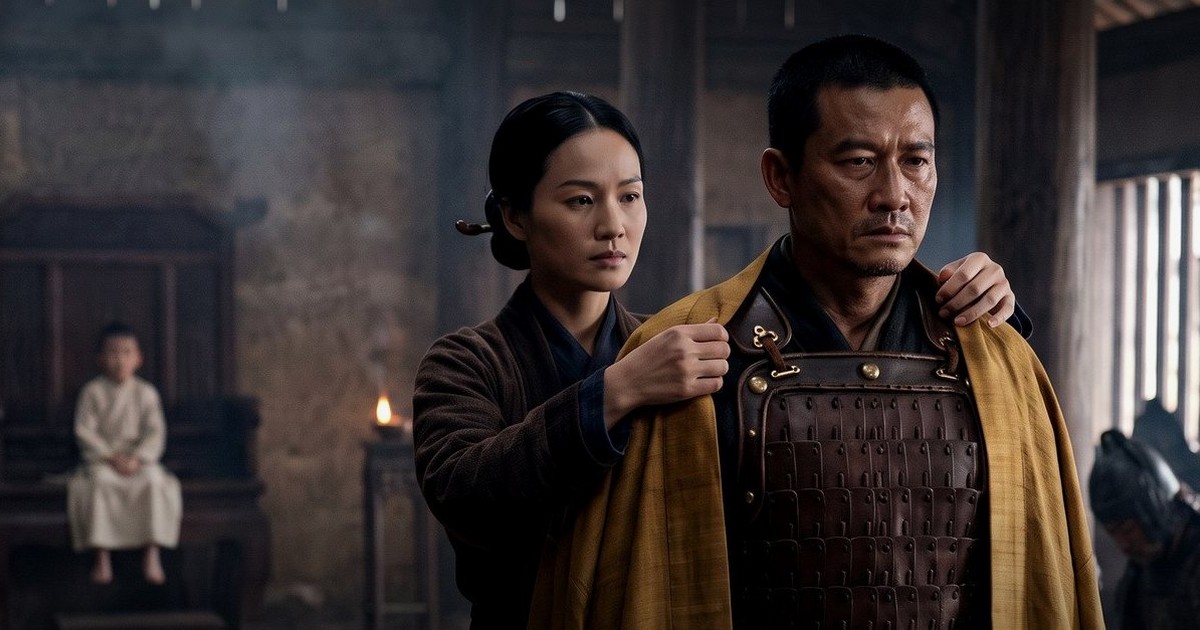
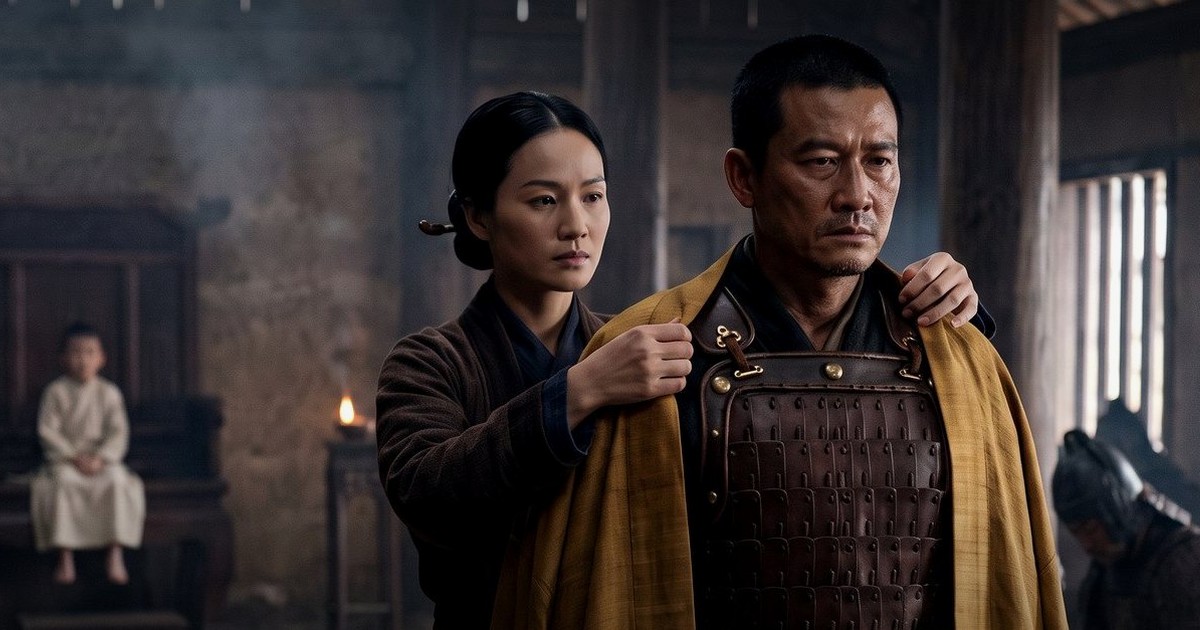
Two people, one gesture, and a state that survives it. The series’ share image is the whole relationship in a frame: a woman in a dark robe lays a gold cloth over the shoulders of an armoured man, and a child sits on a throne behind them. The record gives the act behind the picture. It does not give what passed between the two adults before or after it — and the drama has built a whole season out of that gap.
One point of language first. The chronicle calls her Dương thị, and her formal title, after her second marriage, is Đại Thắng Minh Hoàng hậu; “Dương Vân Nga” is the later name the series uses. The name is not a claim, and this page does not build one on it.
The chronicle gives four entries in sequence. In 979, a night of feasting ends with Đinh Tiên Hoàng and Đinh Liễn murdered in the palace courtyard. Her son, the six-year-old Đinh Toàn, succeeds; she becomes dowager empress, and the general Lê Hoàn becomes regent. In 980, after the generals acclaim Lê Hoàn, she orders the imperial robe placed on him and he takes the throne; the Song army mobilises. In 981, Hầu Nhân Bảo is killed and the Song forces retreat.
The marriage comes later. The chronicle places her investiture as one of Lê Hoàn’s empresses after the war — 982 in its count, though some modern summaries put it in 981. The cast notes add two phrasings and no facts. Lê Hoàn is “the man who gained the most from the feast night of 979, and the man who shattered the Song army in 981. Both are true.” She is the “Dowager Empress of Two Dynasties”.
The robe is where the interpretations divide. Confucian historians called her act a lapse of virtue; modern historians call it vision. Framed politically: a child on the throne, a general with the army, an invasion at the border. Whoever commands is the one who can fight, and the order to put the robe on him says so in public while leaving the child visible behind it. Framed dynastically: a woman of the old order hands the realm to its replacement. The series reports both and ranks neither.
The second marriage is the recorded fact that carries the most interpretation. The chronicle places the investiture after the war, and the title — empress of the Đinh and then of the Lê — is the constitutional seal on what the robe began. Read it as statecraft: the new reign is joined to the old one so the child is not discarded. Read it as betrayal: the dowager of one house becomes the consort of the man who replaced it. Both readings need the same fact, and the record supplies only the fact.
The question Season II asks, “Who killed the king — and who profits?”, is the third layer, and it is the record’s silence rather than its content. The chronicle names Đỗ Thích as the killer, and modern historians have contested that. Nothing in the material the site publishes accuses either of these two; the series stages the question because the record leaves it standing.
Both are Season II figures, and the series page lists Act II as “Defence of the Realm (981)”. The first teaser sets their scene in a line: Hoa Lư, 980. A child on the throne, a dowager empress, a general — and a robe that changes hands.
After 981 the record tightens around Lê Hoàn and lets go of Dương thị; her cast tag nevertheless runs through Season III, while his chronicle entry for 1005 is his death. What passes between them after the war — the marriage, its terms, its end — is mostly outside the excerpted material. The drama can invent those years; the record does not supply them.
Everything below is hư cấu and is labelled as such.
The relationship matters because the series is about legitimacy, and this is the moment legitimacy is manufactured in public. A widow, a general and a child are enough to keep a state standing through an invasion — provided the robe moves and the marriage follows. Whether that is a rescue or a theft, statecraft or a lapse, is the argument the record hands down and the drama refuses to close. The robe in the still is gold, the child is small, and the two adults are the ones making the gesture mean something.
The dowager empress who ordered the imperial robe placed on a general's shoulders in 980: a lapse of virtue to some readers, vision to others.
The general who took the robe in 980 and shattered the Song army in 981: Lê Hoàn, the series’ Lê Đại Hành, between the chronicle and the screen.

The last Lê king, an epithet that may be slander, and a death the record leaves unexplained — the series stages four readings of it.