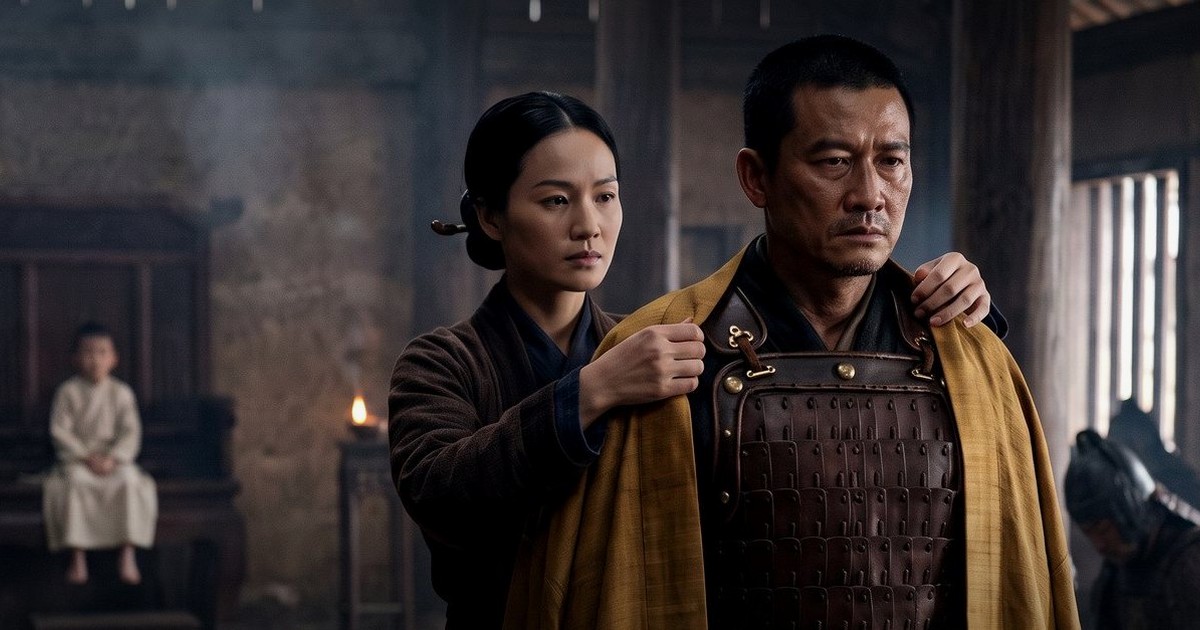
968: the end of the Twelve Warlords
In 968 Đinh Bộ Lĩnh ended the Twelve Warlords and named the realm Đại Cồ Việt. The record gives a sentence; the series builds a season from the silence.
Characters
Eldest son of Ngô Quyền, co-king as Thiên Sách vương from 951 to 954, and the father of a future warlord: what the record gives and later tradition adds.

Ngô Xương Ngập is one of the two brothers whose shared throne is the last stretch of Ngô rule before the collapse. He is elder son of Ngô Quyền, co-king with his younger brother Ngô Xương Văn from 951 to 954 as Thiên Sách vương, and he dies of illness in 954 after a reign that the record describes as monopolised by him and his party. The series does not name him; Season I only summarises the collapse.
The chronicle gives him four things: the co-rule with his brother from 951 to 954, the flight after Dương Tam Kha’s 944 coup to the magnate Phạm Lệnh Công in Nam Sách, a monopoly of power that excluded his brother, and a death by illness in 954. It also records that his son, Ngô Xương Xí, later became one of the Twelve Warlords. No birth year is recorded.
The co-rule is the point that a summary is most likely to lose. For three years the Ngô house had two kings, and the arrangement did not hold: the record says he kept power to himself and that he reportedly planned to remove his brother. The chronicle’s own moral comment on him is also later — it belongs to its commentators.
Later tradition adds a claim this page does not repeat: the Phả hệ họ Ngô makes the monk Khuông Việt — Ngô Chân Lưu — his son. That is a genealogical claim, not a chronicle statement. The moral criticism of him in later histories is also a later layer, not a tenth-century verdict. And the record does not identify his mother.
The Ngô collapse is summarised in Season I and never staged; Xương Ngập has no cast entry, no scene and no line. What the series uses from this generation is the outcome: a house that cannot hold one throne, and twelve rivals who fill the gap.
Everything here is hư cấu. Any scene of him at Nam Sách, in the shared court or on his deathbed is invention; the published material offers none. The still on this page is a Đinh court image, not a portrait of him: no image in the project shows Ngô Xương Ngập.
It does not give a birth year. It does not identify his mother. It does not make Khuông Việt his son, because that is a genealogy and not the record. It does not call him sole king, since 951–954 is co-rule. And it does not say he died by violence: the record says illness.
Because the co-rule is the record’s own answer to how fragile the Ngô house had become. Two kings on one throne, a coup, a flight and an illness death in four years: that is the sequence his page preserves. When he dies in 954 his brother rules alone, and when his brother dies in 965 the line passes into the warlord field his son will join. He is the point where a dynasty’s problem becomes visible.
In 968 Đinh Bộ Lĩnh ended the Twelve Warlords and named the realm Đại Cồ Việt. The record gives a sentence; the series builds a season from the silence.
He ended the Twelve Warlords and gave the realm its name. Then a night of feasting in 979 ended the reign — and the chronicle names a killer.
Ngô Sĩ Liên compiled the Toàn thư in 1479; the first complete print came in 1697. What the chronicle is, how it survives, and what the series takes from it.